How To Play the Visual Memory Test
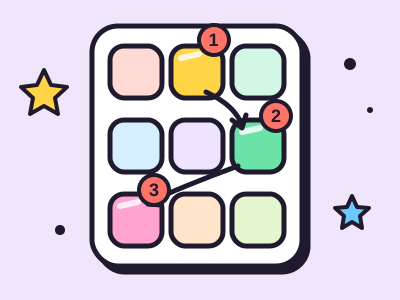
Press Start and look at the grid. A few squares turn purple at the same time. You get about one second to look at them, and then they all go dark again.
Now it is your turn. Tap every square that was purple. The order does not matter. Each square you get right turns purple again so you can see your progress.
Level 1 asks you to remember 3 squares on a small 3 by 3 grid. Every new level adds one more square, and every few levels the grid gets bigger too. By level 12 you are hunting for 14 squares on a 7 by 7 board.
You have three hearts for the whole game. Inside each level you can make two mistakes for free. The third wrong tap in the same level costs you a heart, shows you which squares you missed, and gives you a brand new pattern at the same level. When your last heart is gone, the game ends.
What Your Score Means
Your score is the highest level you fully cleared. If you finish level 8 and run out of hearts on level 9, your score is level 8.
- Levels 1 to 4: a fine warm-up. The jump to the 4 by 4 grid catches lots of people.
- Levels 5 to 8: you are holding a real picture in your head, not just a couple of spots.
- Levels 9 to 12: strong. Big grids with ten or more squares take real focus.
- Level 13 and up: amazing. You are spotting shapes most people never notice.
Scientists who study memory have found that people can only hold about three or four separate objects in short-term visual memory at once. You can beat that here because the lit squares form shapes, and a shape is much easier to keep than a pile of loose dots.
Tips To Improve
- Look for shapes. Three squares in a row become one line. Four squares can be a letter, an arrow or a little face.
- Use the edges. Notice which squares touch a corner or a side. They make great landmarks.
- Split the grid. On a big board, remember the top half and the bottom half as two small pictures.
- Tap your surest squares first. Start with the ones you are certain about, then think about the tricky ones.
- Stay calm after a miss. You get two free mistakes per level, so one red X is not the end.
Why Pictures Stick in Your Head
Your brain is very good at pictures. You can remember a face you saw once or where you left your bag, often without trying. This test turns that skill into a game and makes it harder every level.
It feels different from the sequence memory test, where squares flash one at a time and the order matters. Here everything appears at once, so you remember a whole picture instead of a list. If you would rather train your memory for digits, try the number memory test. And if you like remembering pictures, see how well you can draw flags from memory.