How To Play and Draw a Constellation
A dark square shows the stars of one pattern and nothing else. No names of the bright stars, no lines, no hints about which dot is the shoulder and which is the foot.
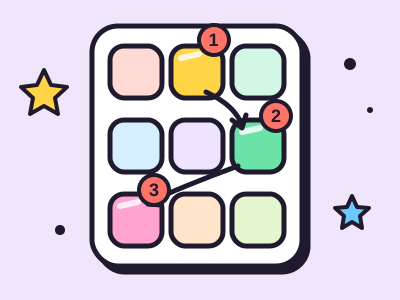
Tap one star, then tap another. A white line joins them. Keep going until the shape looks right to you. Undo removes the last line if a connection feels wrong. When you are happy, press That’s my constellation.
The usual figure then appears on top of your drawing. Green lines are the ones you matched. Gold lines are extras you invented. Dim dashed lines are parts of the figure you left out. A round is five patterns, chosen from twelve.
On a keyboard, move to a star and press Enter or Space, then do the same for the next star.
What Your Score Means
Each pattern earns a percent. Your result is the average of the five.
- Near 100%: you drew almost exactly the lines people use in star books, without many extras.
- Around half: you caught the main shape, like the dipper’s bowl, and missed a tail or added a shortcut.
- A low score: the dots were there, but the figure you remember and the usual one took different paths.
There is no single official drawing in the sky. People agreed on these stick figures so the patterns are easy to teach. Your best average is saved in the browser.
Tips To Improve
- Start with the brightest dots. The biggest stars are the corners of the famous shape.
- Count the lines you expect. The Southern Cross is two lines. Cassiopeia is a zigzag of four. Extra lines lower the score.
- Say the shape out loud. “Bowl then handle” is the whole Big Dipper. “W or M” is Cassiopeia.
- Play the same five again. The order changes, but the twelve patterns do not.
The Patterns in This Sky
The International Astronomical Union lists 88 constellations. This game uses a dozen of the easy ones: Orion, the Big Dipper (part of Ursa Major), Cassiopeia, Cygnus, Leo, Scorpius, Lyra, Crux, the Great Square of Pegasus, Aquila, Gemini and Taurus.
The maps are simplified on purpose. Real stars have exact positions and brightness from catalogs. Here the goal is the figure you would sketch from memory, not a chart you could navigate by. Bigger dots only mean “this star stands out in the stick figure,” not a measured magnitude.